
Rodless Cylinders
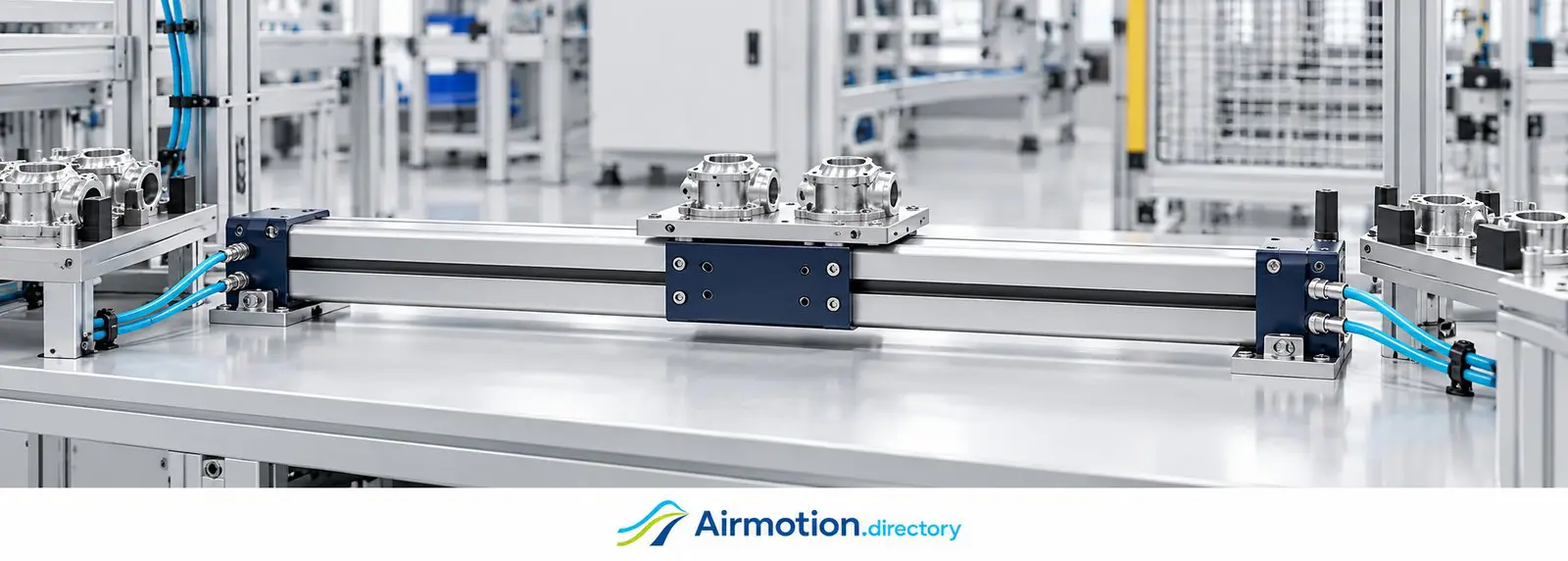
Long travel. Compact layout.
A pneumatic rodless cylinder moves an external carriage along its body instead of extending a piston rod beyond an end cap. This can make a useful difference when a machine needs substantial travel but has limited room for a conventional cylinder’s extended rod.
How does it move the carriage?
Compressed air moves a piston inside the cylinder. In a mechanically coupled design, a connection passes through a longitudinal slot to drive the external carriage, with a sealing arrangement along the slot. In a magnetically coupled design, magnets transmit movement through the cylinder wall without a mechanical connection through that wall.
The coupling method and the load guidance are separate choices. A carriage may need integrated bearings or external guides to carry the load and its turning moments. A rodless cylinder is also not automatically an electric positioning axis. Specify the required stopping positions, accuracy and control method before comparing options.
Three practical applications
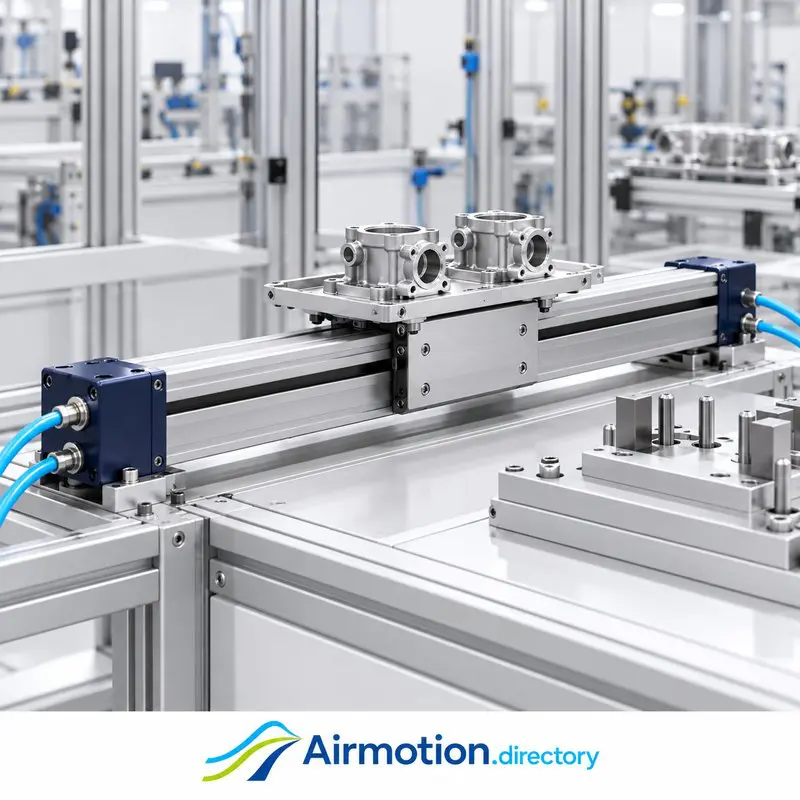
Shuttling a tray
A tray moves between loading and receiving stations along a bench. A rodless carriage can provide the travel without an extending rod occupying space beyond the actuator. Include the tray, parts and offset load when checking the carriage’s load and moment limits.
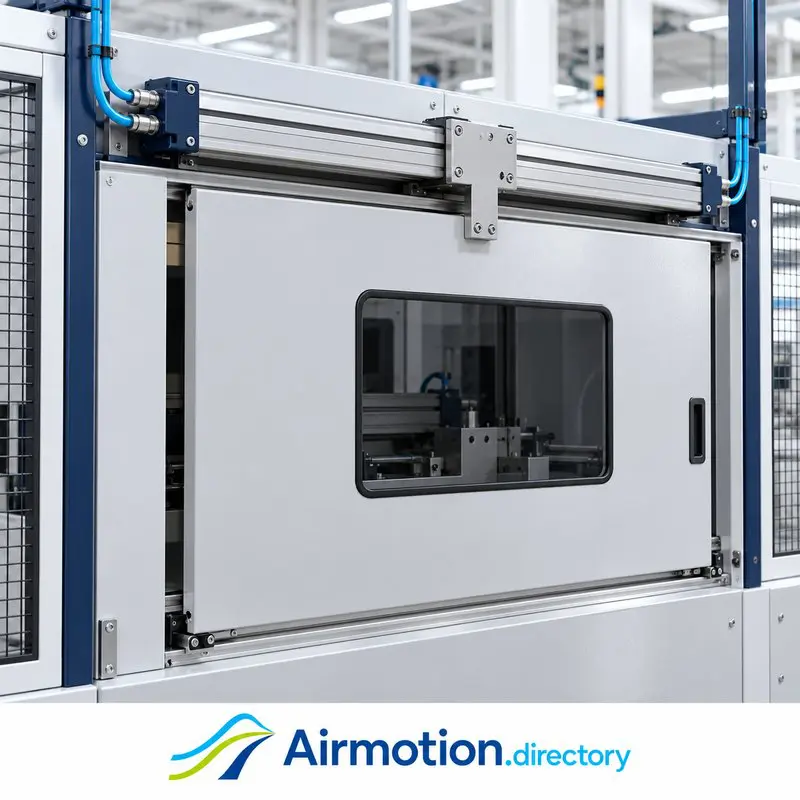
Moving a sliding door
A machine access panel travels horizontally on its own guide rails. A rodless cylinder can supply the driving motion through a suitable connection. Door resistance, stopping energy and alignment affect selection. The actuator alone does not establish the machine’s guarding or interlock requirements.
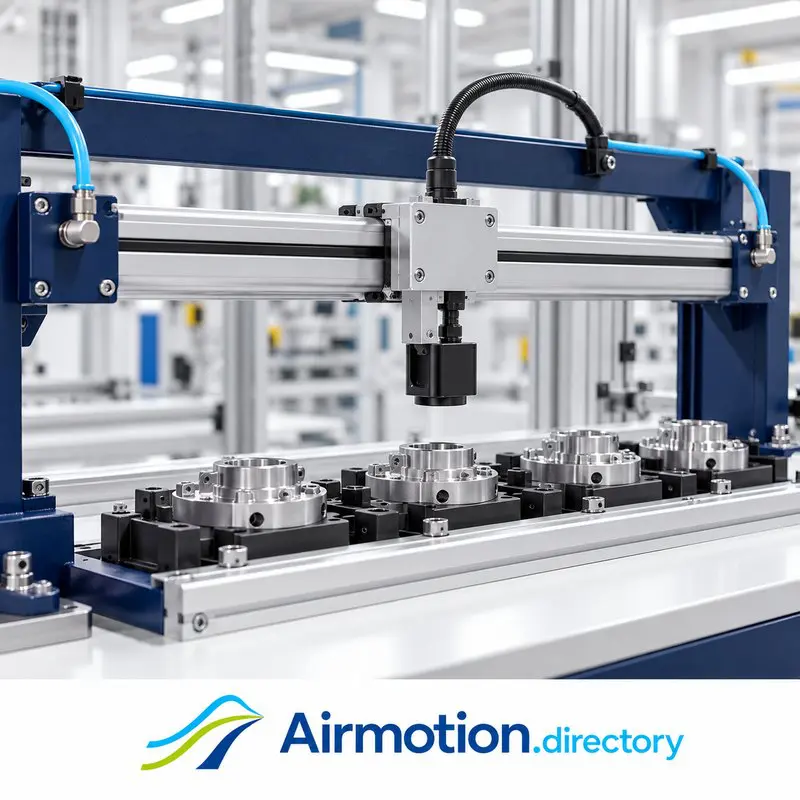
Traversing an inspection sensor
A sensor moves along a row of components in a fixture. A rodless carriage offers a compact route for the traverse, with the sensor cable managed alongside it. Required measurement positions and settling behavior determine whether the proposed pneumatic arrangement is suitable.
Application images are illustrative examples, not photographs of the featured brands’ products or customer installations.
Three brands to know
These independent examples include mechanically and magnetically coupled ranges. Inclusion does not imply that Airmotion Directory represents or supplies the featured brands.
Tolomatic
Tolomatic’s BC2 pneumatic band cylinders use a rodless arrangement with a load-carrying bracket. The range includes mounting options and adjustable cushions. Compare the selected model’s load capacity, mounting requirements and stopping provisions against the actual application.
Pneumax
Pneumax Group’s Series 1605 is a mechanically coupled rodless-cylinder range. Its profiled body accommodates sensor mounting, with end and intermediate supports among the available installation accessories. Specify the complete configuration rather than comparing stroke length alone.
KCC
KCC’s ARM range uses magnetic coupling between the internal piston and external slider. Standard and guided configurations are documented, along with model-specific coupling-force and operating limits. Check coupling strength separately from the guidance needed to support the attached load.
What to compare before choosing
Travel and installed space. Establish the required stroke and check the complete installed length, including end caps, mounts, air fittings and service access. Rodless does not mean the overall length equals the stroke. Compare the envelope with standard pneumatic cylinders.
Moving mass and moments. Include the tooling, tray and workpiece, then locate their center of gravity relative to the carriage. Acceleration, deceleration and offset loads affect selection. If external guidance is needed, its alignment with the actuator matters.
Coupling and guidance. Confirm whether the carriage is mechanically or magnetically coupled. A magnetic coupling can separate if its force limit is exceeded. Guide capacity and coupling strength are different limits. For a shorter supported motion, compare guided cylinders as another category.
Speed, stopping and control. State the travel speed, cycle time, stopping positions and required accuracy. Check cushioning and any external stopping arrangement against the moving load. Flow controls can adjust airflow, but do not turn an ordinary pneumatic cylinder into a precision positioning system.
Installation and upkeep. Check mounting support along long strokes, contamination exposure, seal or band maintenance, sensors, and cable or hose movement. Establish the required behavior on air loss for the actual machine. Match these details to the selected model’s instructions.
What brought you here?
Exploring an application or purchase?
For one defined application question, explore Application IQ. For an actual purchase, quotation or supplier choice, see The Buyer’s Second Opinion.
Working on a customer opportunity?
For one active customer opportunity and its commercial approach, see The Seller’s Second Opinion.
Have a rodless-cylinder requirement?
Share the task, stroke, available installation space, moving mass, load position, mounting orientation, working pressure and cycle time. Include required stopping positions and accuracy, plus a sketch of the load and any separate guides. For a replacement, provide the complete model number, quantity and destination country. Product inquiries are separate from the advisory services above.