

A substantial market within a much larger global sector.
The United States supports demand for pneumatic components, compressors, air treatment, industrial air applications and related services. Its customers buy from domestic manufacturers, international manufacturers, specialist distributors and broad industrial suppliers.
Understanding that demand requires looking at both the scale of the market and the industries purchasing the equipment.
The U.S. share of the global market
Pneumatic components
Estimated U.S. market revenue was US$5.16 billion in 2025, representing 18.7% of the global market. This category includes valves, actuators, air-treatment components and other pneumatic components. Source: Grand View Research
Air compressors
Estimated U.S. market revenue was US$3.43 billion in 2024, representing 12.9% of the global market for stationary and portable air compressors. Source: Grand View Research
These estimates describe different product markets and reference years. They should not be added together as a complete value for the U.S. compressed-air sector.
What current manufacturing activity suggests
In the Federal Reserve’s August 18, 2026 release, U.S. manufacturing output was 1.2% higher than a year earlier and increased 0.2% in July. These figures indicate modest overall growth. Source: Federal Reserve
Airmotion Directory’s interpretation: This supports a picture of continued industrial activity, but does not establish a broad surge in pneumatic or compressor purchases. A supplier’s exposure to particular customer industries can matter more than the headline manufacturing number.
Where demand comes from
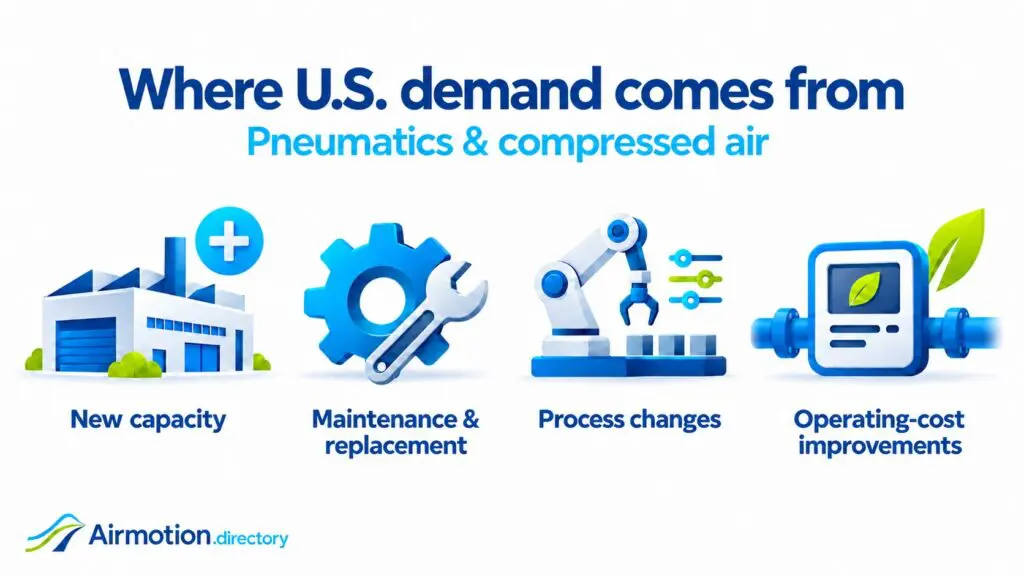
New equipment and production capacity
Machinery builders and expanding facilities purchase pneumatic controls, actuators, compressors and supporting equipment.
Maintenance and replacement
Existing installations require replacement components, repairs, service and equipment renewal. These needs can continue even when investment in new capacity slows.
Changes to existing processes
Automation projects, production changes and different operating requirements can create demand without a new factory being built.
Operating-cost improvements
Air treatment, leak reduction, controls and more efficient equipment may attract investment where the operating savings justify the cost.
These sources of demand should be considered separately. A strong replacement business can coexist with weak new-equipment orders.
What to watch next
Look for agreement between several signals:
- Production trends in the industries purchasing the equipment.
- Machinery and capital-equipment orders.
- Capacity utilization and investment activity.
- Pneumatic and compressor orders or shipments, when comparable data is available.
- Energy, financing and import costs that affect purchasing decisions.
A forecast for long-term market growth does not mean every year, product category or supplier will grow at the same rate.
Find companies serving the U.S. market
Explore manufacturers, specialist distributors and service companies supplying pneumatic and compressed-air products to U.S. customers.