

Understand German demand and put equipment sales in context.
Germany is a substantial market for pneumatic components, compressors and related equipment. Demand comes from machinery production, investment in industrial facilities, maintenance and changes to existing processes.
The size of that market provides context. Production and orders help explain how purchasing conditions are changing.
Germany’s share of the global market
Pneumatic components
Estimated German market revenue was US$1.73 billion in 2025, representing 6.2% of global revenue. This category includes valves, actuators, air-treatment components and other pneumatic components. Source: Grand View Research
Air compressors
Estimated German market revenue was US$2.33 billion in 2024, representing 8.8% of global revenue for air compressors. Source: Grand View Research
These estimates cover different product categories and reference years. They should not be added together as a complete valuation of the compressed-air sector.
Country market share describes revenue attributed to Germany. It does not measure the worldwide sales of German manufacturers or the share of equipment manufactured in Germany.
What current manufacturing activity suggests
Indicator review: September 7, 2026
German industrial production fell 1.1% in July 2026 compared with June, after seasonal and calendar adjustment. The three-month comparison was more positive: production from May through July was 0.4% higher than in the preceding three months. Source: Destatis
Manufacturing orders increased 2.5% in July compared with June. Capital-goods orders increased 2.4%. Orders provide evidence of future work, but they are not equipment deliveries or completed sales. Source: Destatis
Airmotion Directory’s interpretation: The combination suggests uneven industrial conditions. Higher orders provide some support for future activity, while weaker monthly production argues for caution about an immediate, broad increase in equipment purchases.
Pneumatic-component and compressor demand can also move differently from aggregate industrial output. Customer industries, project timing and replacement requirements matter.
Where demand comes from
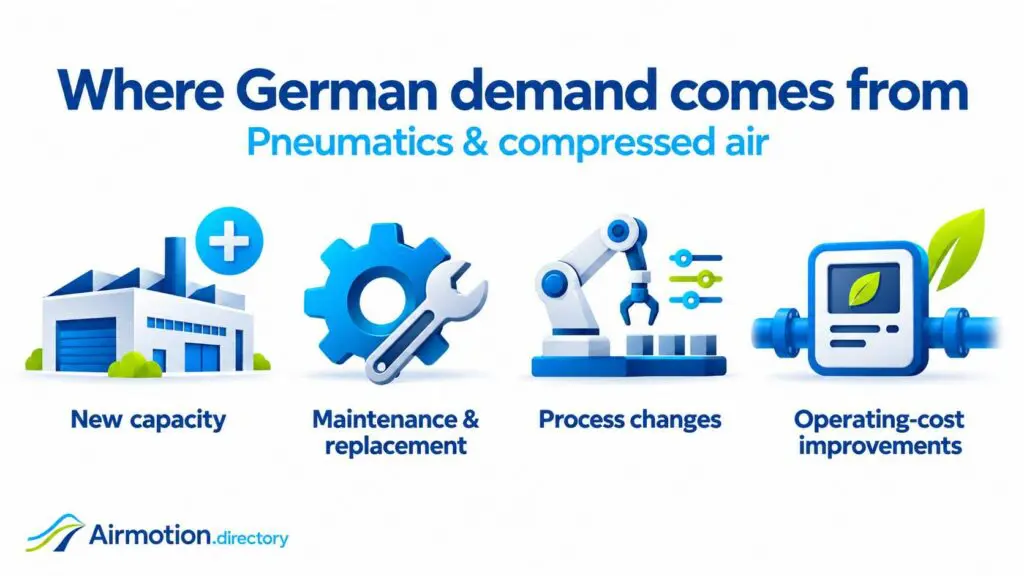
New equipment and production capacity
Machinery construction, new production lines and facility expansion create demand for pneumatic controls, actuators, compressors and supporting equipment. Domestic and export orders for machinery can both affect component purchasing by factories in Germany.
Maintenance and replacement
Existing installations need replacement valves, cylinders, fittings, dryers, filters and compressors. Repairs and equipment renewal can continue when investment in new capacity is subdued.
Changes to existing processes
Automation, handling improvements and production-line changes can require new pneumatic or compressed-air equipment without a new factory being built.
Operating-cost improvements
Leak reduction, pressure management, air treatment, compressor controls and heat recovery can support investment where the expected savings justify the work.
What to watch next
- Industrial production in the customer industries relevant to your business.
- Domestic and foreign manufacturing orders, including machinery and capital goods.
- Whether order growth continues across several months.
- Capacity utilization and investment in existing facilities.
- Comparable pneumatic and compressor orders or shipments, where available.
- Energy and financing costs that affect project economics.
A long-term growth forecast does not establish that every product category or company will grow each year.
About the figures
Market sizes are commercial research estimates. Industrial indicators come from Germany’s Federal Statistical Office, Destatis.
Reference periods and release dates are identified separately. Provisional figures may be revised, and industrial indicators do not directly measure pneumatic-component or compressor purchases.