
Standard pneumatic cylinders
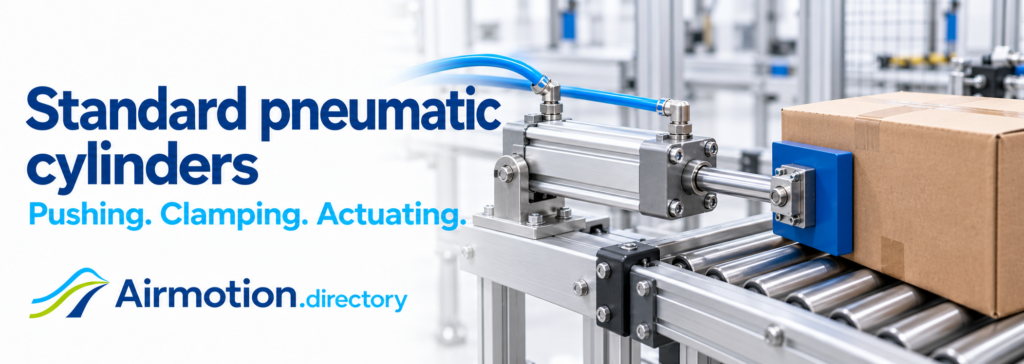
A straight stroke. A useful job.
Pushing a carton, holding a workpiece, or opening a gate all begin with a simple requirement: move something through a defined distance. A pneumatic cylinder converts compressed air into linear force, moving a piston and its attached rod.
This page focuses on standard piston-rod cylinders, including ISO 15552 designs. Double-acting cylinders use air pressure for extension and retraction. Single-acting designs use air pressure in one direction and typically a spring for return. Rodless cylinders, rotary actuators, and electric actuators are different product families.
Three practical applications
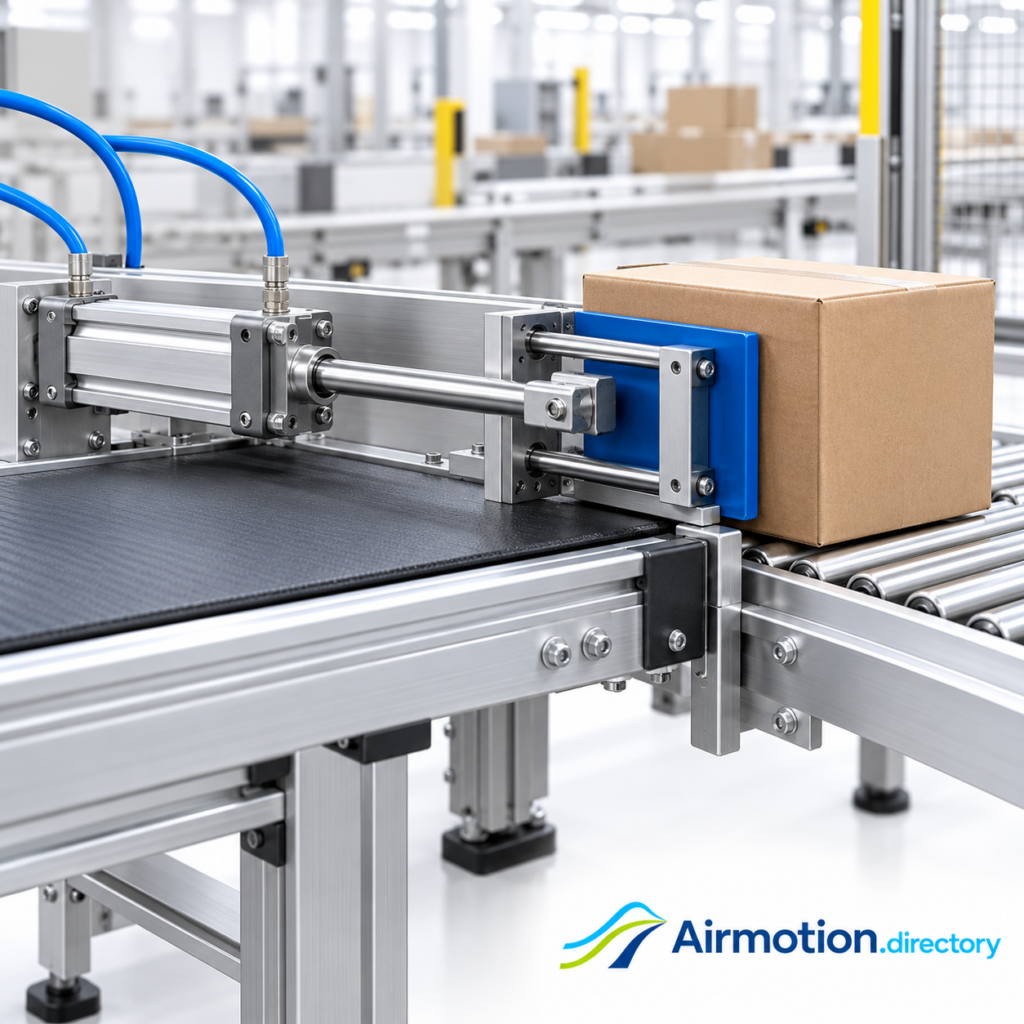
Push cartons between conveyor lanes
A cylinder can drive a pusher plate to move a carton onto another conveyor lane. The carton weight, travel distance, line speed, and available cycle time shape the selection. External guides support the pusher so the piston rod does not have to carry the sideways loading.
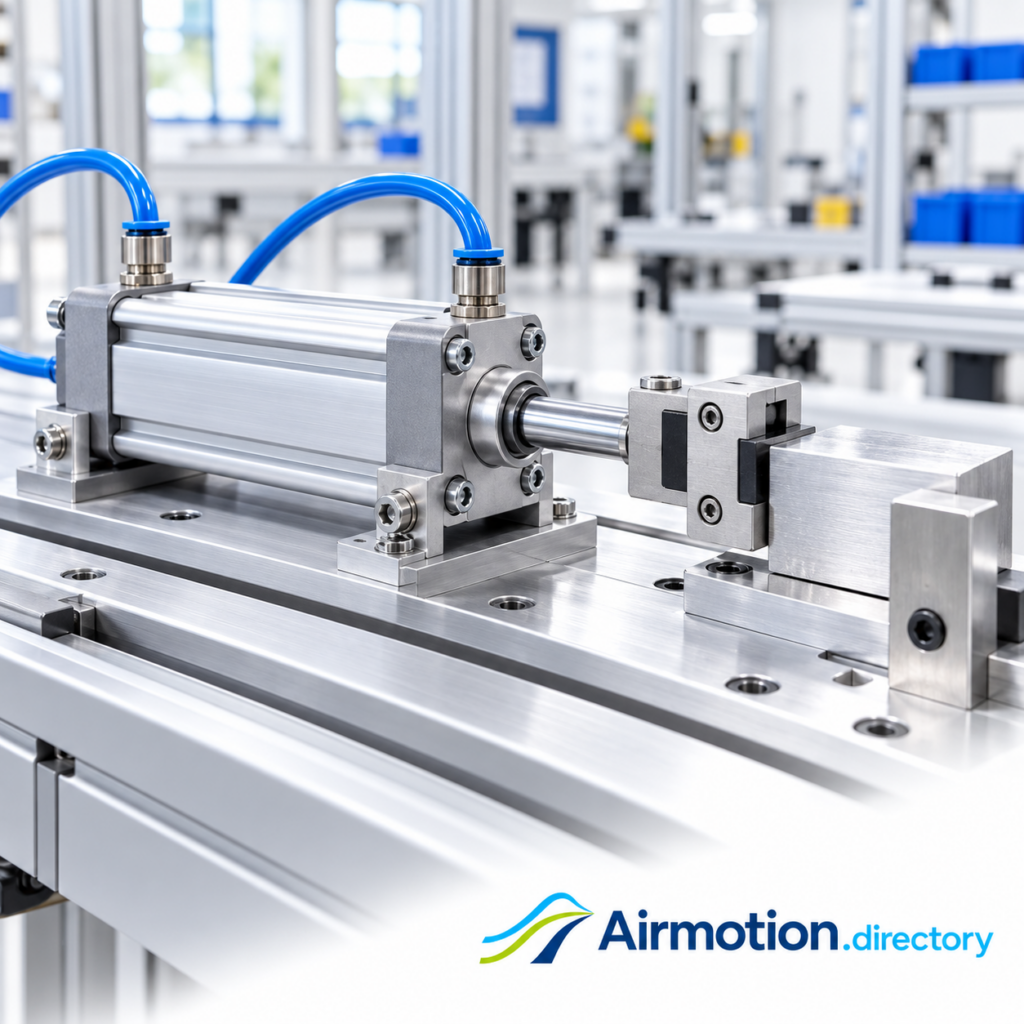
Clamp a workpiece in a fixture
A cylinder can move a clamping jaw to hold a component against a fixed stop during assembly or checking. The fixture supports the workpiece. Required holding force, contact geometry, and the response to a loss of air pressure need consideration together.

Open and close a chute gate
A cylinder can operate a sliding gate that starts or stops material discharge from a chute. Stroke, gate resistance, and the mounting arrangement determine the motion required. Dust, seal suitability, and the required position following air loss also affect the choice.
These are illustrative applications, not reports of specific customer installations.
Three manufacturers to know
Three examples of manufacturers offering standard pneumatic cylinders. Product ranges and configurations differ; this is not a ranking.
Festo
Germany
Offers DSBC standards-based cylinders to ISO 15552. The double-acting range includes adjustable and self-adjusting pneumatic cushioning options, position-sensing arrangements, and mounting accessories. Check the exact variant against the application.
SMC
Japan
Offers CP96 ISO 15552 cylinders, with double-acting single-rod and double-rod configurations. The range includes air and bumper cushioning, with compatible cylinder switches for position detection. Non-rotating variants are offered separately.
IMI Norgren
United Kingdom
Offers ISOLine cylinders to ISO 15552, including double-acting profile-cylinder configurations. Selected versions feature an Adaptive Cushioning System and provision for flush-mounted switches. Materials, ports, and cushioning vary by model.
What matters when comparing cylinders?
Start with the motion and load. Define the force, stroke, direction, speed, and cycle rate. Available force depends on the bore and pressure at the cylinder; retraction force differs from extension force on a single-rod design. Include friction and acceleration in the sizing assessment.
Check more than bore and stroke. ISO mounting dimensions help with replacement selection, but matching two numbers does not establish interchangeability. Compare mountings, rod threads, ports, overall dimensions, cushioning, and sensor compatibility.
Consider the complete arrangement. Guidance, valves, flow controls, sensing, air quality, and the operating environment affect how the cylinder performs. Establish what the machine must do when air or power is lost. A larger cylinder does not solve every motion problem.
What brought you here?
Using or buying pneumatic cylinders?
Exploring one application?
Already considering a purchase, supplier recommendation, or quotation?
Selling pneumatic cylinders?
Working on a specific customer opportunity?
Explore the Seller’s Second Opinion
Own or lead a pneumatic or compressed-air business and want to examine its online revenue system?
Have a pneumatic-cylinder requirement?
Tell Airmotion Directory what needs to move, the required stroke and load, where the equipment will be used, and whether this is a new application or a replacement.